
RuralCareIQ™ helps rural hospitals, health systems, clinics, and provider networks establish provider-led shared-services models for managed IT, cybersecurity, interoperability, compliance, infrastructure, and ongoing technical support.
Managed IT, cloud, help desk, infrastructure, and provider support.
Cybersecurity monitoring, risk management, compliance, response, and recovery.
EHR, HIE, FHIR, referral, and healthcare interoperability support.
A configurable shared-services model for regional provider networks.
Independent rural healthcare organizations often manage complex technology, security, compliance, and interoperability requirements with limited staffing, budgets, and specialized expertise.
RuralCareIQ™ brings technology operations, security, integration, and provider enablement into a coordinated shared-services model that can support multiple participating healthcare organizations.
Centralize essential technology services while allowing each participating organization to maintain its operational identity and clinical independence.
Establish consistent safeguards, monitoring, response processes, and recovery capabilities across participating organizations.
Improve connectivity among clinical systems, providers, partners, and community resources.
Help participating organizations adopt shared tools, improve workflows, and strengthen operational consistency.
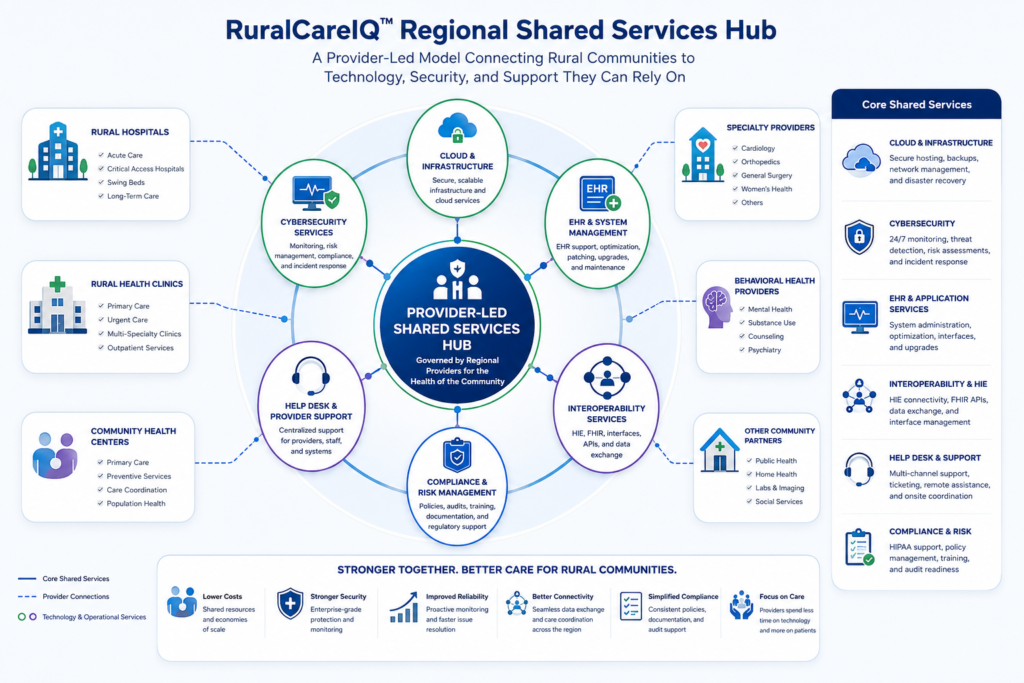
A shared-services model helps rural providers combine resources, standardize essential capabilities, improve technology visibility, and strengthen regional healthcare operations.
The hub provides common technology and operational capabilities while participating providers retain responsibility for clinical care, organizational governance, and local decision-making.
User accounts, permissions, authentication, onboarding, and access reviews.
Workstations, mobile devices, patching, monitoring, and technical support.
Cloud services, servers, networks, connectivity, capacity, and performance.
Centralized requests, issue tracking, escalation, service levels, and reporting
Monitoring, vulnerability management, incident handling, and risk visibility.
EHR coordination, interfaces, HIE connectivity, FHIR, APIs, and data exchange.
Data protection, recovery planning, restoration procedures, and continuity readiness
Policies, service reporting, documentation, audit evidence, and performance reviews.
The hub combines regional coordination with configurable services that can be adopted according to each participating organization’s needs, systems, and readiness.
Define participating organizations, service priorities, responsibilities, decision rights, and regional operating policies
Provide a shared point of contact for user support, technical issues, requests, and escalations.
Coordinate monitoring, assessments, risk remediation, documentation, and response activities.
Support EHR interfaces, HIE connectivity, referrals, FHIR workflows, APIs, and reporting.
Establish backup, restoration, incident response, downtime, and recovery procedures.
Provide onboarding, workflow support, user training, technical assistance, and ongoing improvement.
RuralCareIQ™ helps rural providers reduce operational burden by sharing essential technology, security, integration, and support services. This coordinated model improves consistency, resilience, and scalability while preserving local clinical leadership.
Consolidate repetitive technology, security, vendor, and support activities.
Apply common standards and processes across participating organizations.
Provide dashboards and reporting for incidents, requests, risks, systems, and performance.
Add new locations, providers, services, and regional partners through a configurable model.
The hub aligns participating organizations, shared capabilities, operational processes, and continuous improvement through a coordinated regional model.
Review providers, locations, technology environments, risks, systems, priorities, and readiness.
Establish governance, service scope, responsibilities, standards, and implementation phases.
Onboard users, systems, support processes, security controls, integrations, and documentation.
Deliver shared IT, cybersecurity, interoperability, help desk, training, and technical assistance.
Track service performance, risks, incidents, adoption, outcomes, and regional priorities.
RuralCareIQ™ combines operational support, security, integration, infrastructure, governance, and provider enablement into a configurable shared-services framework.
Manage participating organizations, service catalogs, responsibilities, requests, and performance.
Support networks, servers, cloud environments, devices, capacity, and availability
Maintain assessments, policies, evidence, corrective actions, and compliance documentation.
Coordinate backups, recovery testing, downtime processes, restoration, and resilience planning.
Track incidents, requests, escalations, assignments, resolution status, and service trends.
Monitor threats, vulnerabilities, incidents, remediation activities, and security posture.
Manage EHR interfaces, HIE connectivity, referrals, FHIR, APIs, and exchange workflows.
Support onboarding, workflow redesign, adoption, documentation, and continuous improvement.
RuralCareIQ™ is designed to help rural hospitals, health systems, clinics, and regional provider networks establish a coordinated shared-services model while preserving local clinical leadership, organizational independence, and community priorities.
Participating providers retain governance, clinical responsibility, and decision-making authority, while Yaqeen Technology supports planning, implementation, managed technology operations, cybersecurity, interoperability, compliance, training, reporting, and ongoing technical assistance.
Use RuralCareIQ™ to coordinate shared technology services, improve cybersecurity and interoperability, support participating providers, and create a more sustainable regional operating model.